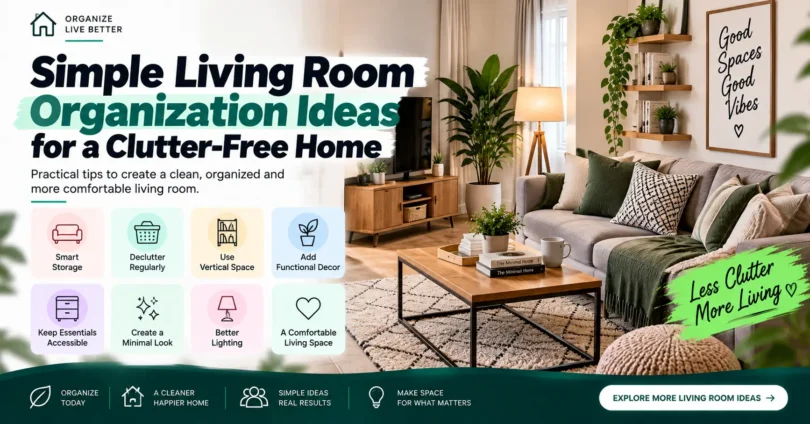

Simple living room organization ideas can make even a busy or compact home feel calmer, cleaner, and easier to use. You do not need expensive furniture, a large room, or a complete makeover. In most cases, better organization starts with removing unnecessary items, giving everyday belongings a fixed place, and making smarter use of the storage you already have.
For homes in India, living rooms often serve several purposes. The same room may be used for relaxing, entertaining guests, watching television, studying, and spending time with family. This makes practical organization Simple Living Room especially important.
This guide explains how to organize your living room step by step, use small spaces efficiently, control everyday clutter, arrange furniture thoughtfully, and create storage that is easy to maintain.
What Does Living Room Organization Really Mean?
Living room organization means arranging furniture, storage, décor, electronics, and everyday belongings so the room remains functional and easy to maintain. It is not simply about making everything look neat.
A well-organized room should allow you to find commonly used items quickly, move around comfortably, clean surfaces easily, and return things to their proper places without much effort.
Good organization usually combines three principles: decluttering, smart storage, and practical placement. When these work together, the living room can stay tidy without requiring constant cleaning and rearranging.
Start by Decluttering the Living Room
Decluttering is the best first step because adding more storage will not solve the problem if the room contains things you no longer need.
Instead of trying to reorganize everything at once, work through the living room in categories. Check books, magazines, toys, cables, remote controls, décor, cushions, paperwork, and miscellaneous objects separately.
Use a Simple Sorting Method
Create four categories while decluttering:
- Keep items that are useful or meaningful.
- Move belongings that actually belong in another room.
- Donate or give away usable items you no longer need.
- Discard damaged or unusable items responsibly.
Once unnecessary belongings are removed, it becomes much easier to understand how much storage the room actually needs.
Avoid removing useful objects simply to achieve an extremely minimal appearance. The goal is a practical home that works for your family, not an empty room.
Give Every Everyday Item a Fixed Home
One of the most effective simple living room organization ideas is to assign a permanent location to frequently used items.
Remote controls might belong in a small tray on the coffee table. Newspapers can go into a magazine holder. Children’s toys can have a dedicated basket, while chargers can stay in a labelled drawer.
This simple rule reduces visual clutter because objects are less likely to remain scattered around the room.
Create an Easy Return System
Storage should be convenient enough that everyone can use it.
If putting something away requires opening several boxes or moving other objects first, it will probably end up on a table or sofa again. Keep frequently used items in accessible drawers, baskets, cabinets, or trays.
Less frequently used belongings can be stored higher up or inside closed cabinets.
Use Vertical Space for Extra Storage
When floor space is limited, look upward. Walls can provide useful storage without making the living room feel crowded.
Wall-mounted shelves, floating shelves, tall bookcases, and vertical cabinets can hold books, photographs, décor, plants, or small storage containers.
Vertical storage is especially useful in apartments and compact Indian homes where floor area may be limited.
Keep Wall Storage Balanced
Avoid filling every available section of wall.
A few carefully arranged shelves generally look cleaner than multiple shelves packed with unrelated objects. Leave some open space around decorative pieces so the room does not appear visually heavy.
Heavy objects should always be placed on stable furniture or properly installed shelving designed to support their weight.
Choose Furniture with Built-In Storage
Multi-purpose furniture can reduce the number of separate storage units required in a living room.
A storage ottoman, coffee table with drawers, TV unit with cabinets, or bench with internal storage can serve two purposes while occupying roughly the same amount of floor space.
For example, a storage ottoman can provide seating while holding blankets, board games, or other occasional-use items.
Useful Multi-Purpose Furniture
Consider furniture such as:
- Coffee tables with drawers or shelves
- Ottomans with hidden compartments
- TV units with closed cabinets
- Benches with storage underneath
- Side tables with drawers
- Sofas with built-in storage, where suitable
Before buying new furniture, measure your available space carefully. Extra storage is helpful only when the furniture itself does not make movement difficult.
Organize the TV and Entertainment Area
The television area often becomes a clutter hotspot because it brings together cables, remotes, streaming devices, speakers, gaming accessories, and other electronics.
Start by removing equipment that is no longer used. Then group related accessories together and keep smaller items in a drawer, tray, or labelled container.
Cable clips, sleeves, or simple cable ties can help keep wires grouped and reduce tangling. Avoid tightly bending, crushing, or covering cables in ways that may damage them or interfere with ventilation around electronic equipment.
Keep the TV Unit Simple
Try to keep the visible surface of your TV console relatively clear.
A television, one or two decorative items, and essential equipment are often enough. Store less attractive accessories inside drawers or cabinets whenever practical.
This reduces visual noise and also makes dusting easier.
Use Baskets and Boxes for Small Items
Baskets are useful because they can quickly group items that otherwise create clutter.
A basket near the sofa can hold throws. Another can contain children’s toys, while smaller containers can organize chargers, stationery, or frequently used accessories.
For open shelving, matching or visually coordinated storage boxes can create a cleaner appearance.
Do Not Turn Baskets into Hidden Clutter
Storage containers work only when their purpose is clear.
Avoid throwing unrelated items into the nearest basket whenever you clean. Eventually, the container becomes another clutter zone.
Assign each basket or box a specific category and periodically remove things that no longer belong there.
Create a Clutter-Free Coffee Table
The coffee table is one of the most visible surfaces in a living room, which means even a few scattered items can make the whole space look untidy.
Keep only the things you regularly use or intentionally display.
A tray is particularly useful because it groups small objects into one defined area. You might use it for remote controls, coasters, or one decorative item.
If your coffee table has lower shelving or drawers, use those areas for less attractive essentials.
Arrange Furniture for Easy Movement
Organization is not only about storage. Furniture placement has a major effect on how comfortable and functional the room feels.
Arrange larger pieces first, such as the sofa, TV unit, and main chairs. Then make sure people can move between seating areas and entrances without constantly walking around obstacles.
Do not add side tables, stools, or decorative furniture simply because an empty corner exists. Open floor space is useful and can make a room feel more comfortable.
Define Different Zones
If your living room serves multiple functions, divide it into simple activity zones.
For example, one section might be the primary seating area, while another corner contains a reading chair and lamp. A small study area can be positioned separately if the living room also functions as a workspace.
These zones help prevent belongings from different activities spreading throughout the entire room.
Make Better Use of Corners
Unused corners can provide storage or functionality without interfering with the main seating area.
Depending on the size and layout of the room, a corner could hold a narrow bookshelf, floor lamp, plant, compact cabinet, or reading chair.
However, not every corner needs to be filled. Sometimes leaving a corner empty creates useful breathing room and makes a compact living room appear less crowded.
Organize Books and Decorative Items
Bookshelves often become overcrowded because they gradually collect books, paperwork, souvenirs, photographs, and unrelated household items.
Begin by grouping books logically. You could organize them by category, frequency of use, or size depending on what is easiest for you.
Decorative pieces should be selected more carefully. Displaying fewer meaningful objects can make each one more noticeable while keeping shelves easier to clean.
Use Closed Storage for Visual Clutter
Not everything needs to be displayed.
Documents, chargers, spare accessories, and other practical objects are usually better suited to closed drawers, cabinets, or labelled boxes.
Open shelving works best for items that are both useful and visually suitable for display.
Create a Simple Entry Drop Zone
If your main entrance opens directly into the living room, everyday belongings can quickly accumulate near the door.
A small designated drop zone can help contain this clutter. Depending on your available space, use a compact console, wall hooks, tray, basket, or drawer.
Keys, wallets, reusable bags, and other frequently carried belongings should have a specific place.
Avoid allowing the drop zone to become permanent storage for unopened mail, shopping bags, or miscellaneous items.
Use Storage Under Furniture Carefully
Unused space under suitable furniture can provide additional storage, particularly in compact homes.
Low storage boxes may fit beneath benches, consoles, or other raised furniture. These areas work best for items that are needed occasionally rather than every day.
Choose containers that fit completely underneath so they do not interfere with walking or make the room look cluttered.
Always consider airflow and cleaning access before filling every available gap.
Organize Children’s Toys in a Shared Living Room
When children use the living room regularly, expecting the space to remain completely toy-free may be unrealistic. A better approach is to make cleanup quick and predictable.
Use one or two accessible baskets, drawers, or low storage units for commonly used toys. Children can learn where items belong when categories are simple and storage is easy to reach.
Rotate toys when appropriate rather than keeping every toy in the living room at once. Store less frequently used items elsewhere and bring them back when needed.
Keep Papers and Magazines Under Control
Bills, school papers, newspapers, magazines, receipts, and delivery menus can quickly cover tables and shelves.
Avoid using the living room as permanent document storage. Keep important paperwork in a dedicated filing location and recycle unnecessary paper where local recycling facilities allow.
For magazines or newspapers you are actively reading, use one holder or basket. When it becomes full, review its contents before adding more.
This creates a natural limit and prevents paper clutter from continuously growing.
Make Small Living Rooms Feel More Organized
Small living rooms benefit from fewer objects, appropriately scaled furniture, and storage that makes good use of walls.
Avoid oversized furniture that restricts movement. Choose pieces according to the actual dimensions of the room rather than how they look in a showroom or online photograph.
Closed storage can also be valuable because it reduces the number of objects visible at once.
Mirrors can reflect light and create a greater sense of openness, although they do not physically increase space. Position them thoughtfully rather than using them solely as a storage solution.
Open Storage vs Closed Storage
Both storage types can work well, but they serve different purposes.
| Storage Type | Best For | Main Benefit | Possible Limitation |
|---|---|---|---|
| Open shelves | Books, plants, décor | Easy access and display | Can look cluttered quickly |
| Closed cabinets | Electronics, papers, accessories | Hides visual clutter | Items may be forgotten |
| Baskets | Toys, throws, daily items | Flexible and quick to use | Can become disorganized |
| Drawers | Remotes, chargers, stationery | Keeps small objects contained | Needs occasional sorting |
| Wall shelves | Books and décor | Saves floor space | Requires secure installation |
A balanced living room often uses both open and closed storage. Display attractive items while hiding everyday objects that create unnecessary visual noise.
Simple Living Room Organization Ideas on a Budget
You do not need to buy a complete storage system to improve your living room.
Start by reusing what you already own. Existing trays, boxes, baskets, jars, cabinets, and unused containers may solve many small storage problems.
Move furniture before replacing it. Sometimes a different layout improves both movement and available storage without costing anything.
If you decide to buy organizers, purchase them only after decluttering and measuring the space. Otherwise, you may simply end up organizing unnecessary belongings inside new containers.
Common Living Room Organization Mistakes
A few common mistakes can make organization harder to maintain.
Buying storage before decluttering is one of the biggest problems. More containers can hide excess belongings temporarily without solving the underlying issue.
Another mistake is placing frequently used items in inconvenient locations. If you use something every day, its storage should usually be easy to access.
Also avoid overcrowding shelves, covering every surface with décor, ignoring cable clutter, or using the living room as permanent storage for items that belong elsewhere.
Most importantly, do not design an organization system that takes too much effort to maintain. Simple systems are usually easier for everyone in the household to follow.
How to Keep Your Living Room Organized Every Day
The easiest organization system is one that requires only a few minutes of maintenance.
At the end of the day, return remote controls, toys, books, cushions, and other frequently used items to their designated locations. Clear cups, dishes, packaging, and objects that belong in other rooms.
Once a week, check common clutter areas such as the coffee table, TV unit, entrance, and side tables.
Occasionally review drawers and baskets as well. Hidden storage can become cluttered even when the visible room looks tidy.
Consistency matters more than perfection.
Frequently Asked Questions
What is the easiest way to organize a living room?
Start by removing rubbish and items that belong elsewhere, then declutter what remains. Give frequently used objects such as remote controls, books, toys, and chargers permanent storage locations. Keep visible surfaces relatively clear and use accessible baskets, drawers, or cabinets so returning items takes only a few seconds.
How can I organize a small living room with little storage?
Use vertical space, multi-purpose furniture, wall-mounted shelves, baskets, and closed cabinets where appropriate. Prioritize belongings you genuinely use and avoid filling every available area. Choosing furniture that suits the room’s dimensions is also important because oversized pieces can reduce both movement and usable storage space.
How can I make my living room look less cluttered?
Reduce the number of objects displayed on visible surfaces and group smaller items in trays, baskets, drawers, or cabinets. Manage loose cables and remove objects that belong in other rooms. Leaving some open space on shelves, tables, and floors can make the entire living room feel calmer and more orderly.
How do I organize a living room on a low budget?
Begin with decluttering because it costs nothing and may reduce your storage needs. Reuse existing boxes, baskets, trays, and furniture before purchasing organizers. Rearranging furniture can also improve the layout for free. When buying storage, measure carefully and choose only pieces that solve a specific organization problem.
How do I keep my living room organized with children?
Create simple, accessible storage that children can understand and use. Low baskets or drawers are useful for frequently used toys, books, and craft supplies. Keep categories broad enough to make cleanup easy. Instead of trying to hide every toy, focus on creating a routine where belongings can be returned quickly after use.
Conclusion
The best simple living room organization ideas focus on making your space easier to use rather than simply making it look perfect. Start by decluttering, assign permanent locations to everyday belongings, use vertical and hidden storage wisely, and arrange furniture so people can move comfortably.
For compact homes, multi-purpose furniture, baskets, wall storage, and carefully selected décor can make particularly good use of limited space. The most effective system is one your Simple Living Room household can maintain without much effort.
Start with one clutter hotspot today—such as the coffee table, TV unit, or entrance. Organize that area completely before moving to the next. Small improvements made consistently can gradually create a cleaner, calmer, and more functional living room.