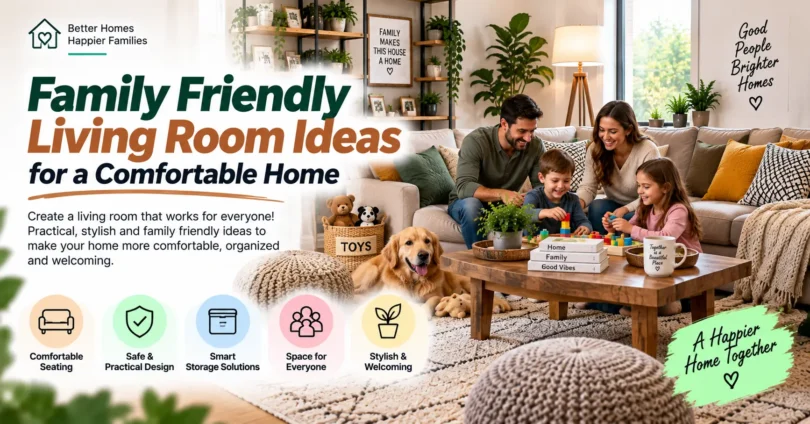

Family friendly living room ideas focus on creating a space where children and adults can relax, play, talk, entertain guests, and spend everyday time together comfortably. A successful family living room does not have to sacrifice style for practicality. With thoughtful furniture, easy-to-clean materials, smart storage, and a flexible layout, the room can be attractive and functional at the same time.
For Indian homes, the living room often serves several purposes. It may be a television room in the evening, a play area during the day, a place for guests on weekends, and sometimes even a temporary study or work zone. This makes flexible design especially valuable.
The best approach is to understand how your family actually uses the room before buying furniture or choosing décor. This guide covers practical layouts, furniture, storage, lighting, colours, safety, and maintenance ideas that can help create a comfortable living room for everyday family life.
What Makes a Living Room Family Friendly?
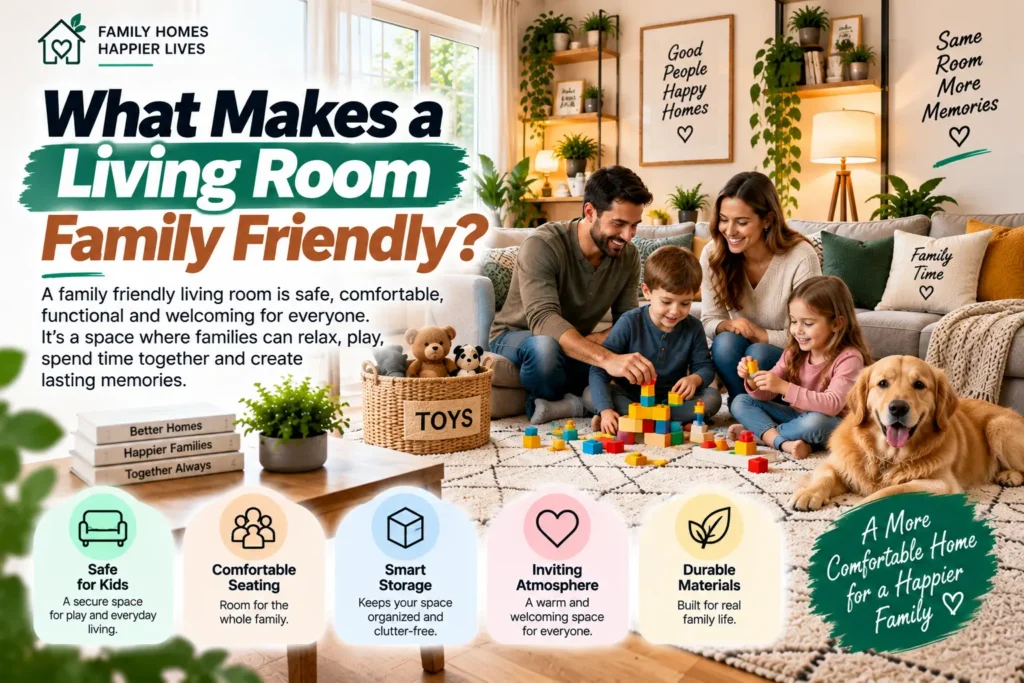
A family-friendly living room is comfortable, practical, adaptable, and easy to maintain. Instead of designing the space only for appearance, every major choice should support the daily activities of the people who use it.
A beautiful white sofa, for example, may look impressive in a showroom but could require more maintenance in a busy household. Similarly, an oversized centre table might look stylish but reduce valuable floor space for children or make movement difficult.
A practical family room usually combines:
- Comfortable seating for different age groups
- Clear and safe walking paths
- Accessible everyday storage
- Durable, easy-care materials
- Flexible furniture arrangements
- Suitable task and ambient lighting
- Space for entertainment and family activities
- Personal décor that makes the room feel welcoming
The goal is not to make the living room completely child-focused. Instead, create a balanced room that works for everyone living in the home.
Plan the Living Room Around Your Family’s Routine
Before decorating, identify the activities that happen most often in your living room. Your daily routine should influence the layout more than design trends.
A family that regularly watches movies together will have different priorities from one that frequently entertains relatives. Similarly, a household with younger children may value open floor space and toy storage, while families with older children may need charging points, reading areas, or study space.
Identify Your Main Activities
Write down the main purposes of your living room. These might include watching television, playing, reading, entertaining guests, doing homework, having conversations, or enjoying tea together.
Once you know the priorities, give the most important activities enough space. Less frequent activities can be supported with movable or multipurpose furniture.
Create Clear Movement Paths
Avoid placing furniture where people naturally walk through the room. There should be comfortable routes between the entrance, sofa, balcony, television area, and adjoining rooms.
This is especially useful in compact Indian apartments, where a living room may connect several parts of the home. An uncluttered path also makes the room feel more spacious.
Choose Durable and Comfortable Furniture
Furniture is one of the most important parts of family friendly living room ideas because it needs to handle frequent use while remaining comfortable.
Prioritise sturdy construction and practical upholstery rather than selecting furniture based only on appearance. Sofas with removable or washable covers can be particularly convenient in homes with children.
Pick the Right Sofa
Choose a sofa according to the room dimensions and number of regular users. A large sectional can work well in a spacious room, while a compact three-seater paired with movable chairs may be more practical in a smaller apartment.
Consider upholstery that is relatively easy to clean and suitable for your climate. Removable cushion covers can simplify regular maintenance.
Neutral colours such as beige, grey, taupe, or muted brown are versatile, but medium tones may be more forgiving of everyday marks than extremely light shades.
Use Rounded Furniture Where Practical
Furniture with rounded or softened corners can be a practical choice in areas where children frequently move and play. Coffee tables, side tables, and storage units are available in many curved designs, so safety-conscious choices do not have to look childish.
Whatever furniture you select, make sure it is stable and appropriate for its intended use.
Consider Multipurpose Pieces
Furniture that performs more than one function can make a family room easier to manage.
An ottoman may provide seating, storage, and a place to rest your feet. A nesting table set can be separated when guests arrive and tucked together afterwards. A storage bench can provide additional seating while keeping less frequently used items organised.
Add Smart Storage Without Making the Room Feel Crowded
Good storage makes it easier to keep a busy family living room organised. The most useful storage is convenient enough that family members can actually use it every day.
Closed storage can hide visual clutter, while open shelves are better suited to attractive objects, books, photographs, and plants.
Use Low-Level Storage for Everyday Items
Low cabinets, baskets, or drawers can make frequently used items easier to access. Toys, board games, books, and craft supplies can have their own designated places.
For households with young children, storage furniture should be stable and positioned with safety in mind.
Make Use of Vertical Space
When floor area is limited, vertical storage can provide additional capacity without overcrowding the room.
Tall shelving, wall-mounted cabinets, or built-in units can store books, décor, and entertainment accessories. Frequently handled items should remain within comfortable reach, while higher areas can hold objects used less often.
Give Everything a Home
Organisation becomes much easier when each item has a defined location. Instead of having one large miscellaneous drawer, separate frequently used objects into logical categories.
A small tray can hold remote controls. A basket can contain toys. Another cabinet section can store board games, cables, or stationery.
This simple system can reduce everyday clutter without requiring constant cleaning.
Create a Flexible Layout for Children and Adults
Flexible layouts are among the most practical family friendly living room ideas because family needs change throughout the day.
Instead of filling every corner with furniture, preserve some open floor area. This gives younger children room to play and allows the space to be rearranged when guests visit.
Choose Furniture That Is Easy to Rearrange
Lightweight accent chairs, pouffes, stools, and nesting tables make a room more adaptable. They can be moved for conversations, celebrations, games, or additional seating.
Large pieces such as the main sofa and television unit can remain fixed, while smaller items provide flexibility.
Create Small Activity Zones
A single living room can support several activities without building permanent partitions.
One corner could become a reading area with a comfortable chair and lamp. Another section could contain a small toy basket. A console may double as occasional study space.
In open-plan homes, a rug or furniture arrangement can visually define each zone without closing off the room.
Select Family-Friendly Flooring and Rugs
Living room flooring should be comfortable, durable, and manageable to clean. The best choice depends on the home’s climate, maintenance preferences, and existing construction.
Tiles are common in Indian homes because they are generally easy to maintain. Other households may prefer stone, wood-look flooring, or existing marble surfaces.
Rugs can add warmth and softness without replacing the entire floor. A rug also helps visually define the seating area.
For a busy household, consider rugs that are manageable to clean and appropriately sized for the space. Avoid arrangements that create obvious tripping points along frequently used paths.
Use Colours That Feel Warm and Practical
A family room can be colourful without becoming visually overwhelming. A balanced palette often works better than filling every surface with strong colours.
Start with one or two versatile base shades and introduce personality through cushions, artwork, rugs, curtains, and accessories.
Warm neutrals, earthy greens, muted terracotta, soft greys, cream, and natural wood tones can work particularly well in Indian interiors.
Add Colour Through Replaceable Accessories
If you enjoy changing the appearance of your home, keep expensive furniture relatively versatile and experiment with affordable accessories.
Cushion covers, throws, artwork, and curtains are easier to replace than a sofa or large storage unit. This approach allows the living room to evolve without requiring a major renovation.
Improve Lighting for Different Family Activities
A single ceiling light is rarely ideal for every activity. Layered lighting allows the living room to adapt to reading, television, conversations, homework, and entertaining.
Use natural daylight whenever possible, then supplement it with artificial lighting according to how the room is used.
Combine Different Types of Lighting
Ambient lighting provides overall illumination. Task lighting supports activities such as reading or studying, while accent lighting can highlight artwork or architectural details.
For example, a ceiling fixture can provide general light while a floor lamp near an armchair creates a dedicated reading corner.
Warm-toned lighting can create a relaxed atmosphere in the evening, while brighter task lighting may be useful where reading or detailed activities take place.
Design a Practical TV and Entertainment Area
The television often becomes the focal point of a family living room, but it does not need to dominate the entire design.
Choose a TV unit with enough storage for the devices and accessories your household actually uses. Concealing loose cables can create a cleaner appearance and reduce clutter.
Position seating so people can watch comfortably without blocking major walkways. Avoid placing decorative objects where they interfere with screens, speakers, ventilation, or frequently used controls.
For households where the television is not used constantly, consider making artwork, shelving, or a feature wall another visual focal point.
Make the Living Room Safer for Children
Homes with younger children require additional attention to furniture placement, storage, and accessible objects. Safety should be integrated into the design rather than treated as an afterthought.
Potential risks depend on the child’s age and the specific room, so parents and caregivers should assess the space according to their household.
Practical considerations can include securing furniture that could tip, keeping hazardous objects out of reach, managing loose electrical cables, and avoiding unstable decorative pieces in play areas.
Windows, balconies, electrical outlets, blinds, and other household features may require age-appropriate safety measures as well.
A family-friendly room should remain attractive, but items that can create avoidable risks should not be placed purely for decoration.
Add Personal Touches That Celebrate Family Life
A practical living room should still feel personal. Family photographs, children’s artwork, travel memories, books, handmade objects, and meaningful décor can give the room character.
Instead of displaying everything at once, select a smaller number of pieces and rotate them occasionally.
A gallery wall can be an effective way to display family photographs and artwork while keeping tables and cabinets less cluttered. Frames do not have to match perfectly, but repeating a few colours or materials can create visual consistency.
Indoor plants can also add texture and freshness. When children or pets are present, choose plant varieties and placements appropriate for your household.
Family Friendly Living Room Ideas for Small Indian Homes
Small living rooms benefit most from furniture that is correctly scaled and capable of performing multiple functions.
Oversized sofas, deep entertainment units, and too many side tables can quickly make a compact room difficult to navigate. Instead, prioritise the pieces your family genuinely uses.
Consider:
- Choosing a compact sofa instead of multiple bulky seating pieces.
- Using wall-mounted storage where appropriate.
- Selecting nesting tables or compact side tables.
- Keeping one clear route through the room.
- Using storage ottomans or benches.
- Choosing visually lighter furniture with suitable proportions.
- Keeping decorative objects limited and intentional.
Mirrors can reflect light and make a room feel visually more open, but they do not create actual floor space. Good furniture proportions and an uncluttered layout remain more important.
How to Make a Family Living Room Easy to Clean
An easy-to-maintain living room saves time because spills, dust, toys, and everyday clutter are inevitable in an actively used family space.
Choose surfaces according to realistic maintenance needs. Washable cushion covers, accessible storage, manageable rugs, and furniture that can be cleaned without specialist care can make everyday upkeep simpler.
Keep cleaning supplies appropriate for each material, since wood, stone, fabric, laminate, and upholstery may require different products.
A quick daily reset can also prevent clutter from becoming overwhelming. Returning remote controls, toys, cushions, books, and chargers to their designated places can take only a few minutes when the storage system is simple.
Common Family Living Room Design Mistakes
One common mistake is purchasing furniture before measuring the room. A sofa may look appropriately sized in a showroom but feel much larger once placed inside a compact home.
Another problem is prioritising appearance over everyday use. Delicate fabrics, unstable tables, excessive decorative accessories, or furniture that blocks movement can make the room frustrating to live in.
Other mistakes include insufficient storage, poor cable management, relying on only one source of lighting, filling every empty corner, and ignoring the changing needs of children.
Perhaps most importantly, avoid copying a showroom layout without considering your family’s routine. Your living room should solve your household’s needs first.
How to Update a Family Living Room on a Budget
You do not need a complete renovation to improve a family living room. Start with changes that solve an actual problem.
If clutter is the main issue, add practical storage. If the room feels uncomfortable, reconsider seating positions. If it feels dark, improve lighting and make better use of natural daylight.
Low-cost updates may include new cushion covers, organised baskets, rearranged furniture, updated curtains, framed family photographs, or a fresh wall colour.
Making one purposeful change at a time can be more effective than purchasing several decorative items without a plan.
Frequently Asked Questions
What are the best family friendly living room ideas for small spaces?
Start with appropriately sized furniture, clear walkways, vertical storage, and multipurpose pieces. A compact sofa, nesting tables, storage ottoman, and wall-mounted shelves can provide functionality without consuming excessive floor area. Keep décor controlled and preserve some open space so the living room remains flexible for different family activities.
Which sofa is best for a family living room?
The best sofa depends on room size, household size, climate, budget, and maintenance needs. Look for sturdy construction, comfortable seating, and practical upholstery. Removable or washable covers can be helpful in busy households. Measure the room, doorways, and circulation space before buying rather than choosing solely according to showroom appearance.
How can I keep a family living room organised?
Create specific storage locations for frequently used items such as toys, books, chargers, remote controls, and games. Combine closed cabinets with baskets, drawers, and selective open shelving. The system should be simple enough for family members to follow consistently. A short daily reset can then prevent small amounts of clutter from accumulating.
How do I make my living room suitable for both children and guests?
Use a neutral foundation and add flexible elements. Comfortable sofas, attractive storage, movable chairs, baskets, and an open area can serve children during normal days while still looking presentable for visitors. Toys can be stored quickly, and lightweight seating can be rearranged when extra guests arrive.
What colours work well in a family living room?
Versatile neutrals and warm natural tones are practical foundations because they work with many décor styles. Beige, taupe, muted grey, cream, earthy green, terracotta, and natural wood shades can create a welcoming atmosphere. Introduce brighter colours through cushions, artwork, rugs, and accessories that can be changed more easily.
Conclusion
The most effective family friendly living room ideas combine comfort, durability, organisation, flexibility, and personal style. A successful living room should make everyday activities easier while remaining welcoming enough for relatives and guests.
Start by analysing how your family actually uses the room. Then improve the layout, choose appropriately sized furniture, create practical storage, add layered lighting, and select easy-care materials. For homes with children, include age-appropriate safety considerations from the beginning.
You do not need to redesign everything at once. Measure your living room, identify the biggest everyday problem, and make one useful improvement first. A family-focused space develops naturally when every design choice has a clear purpose.